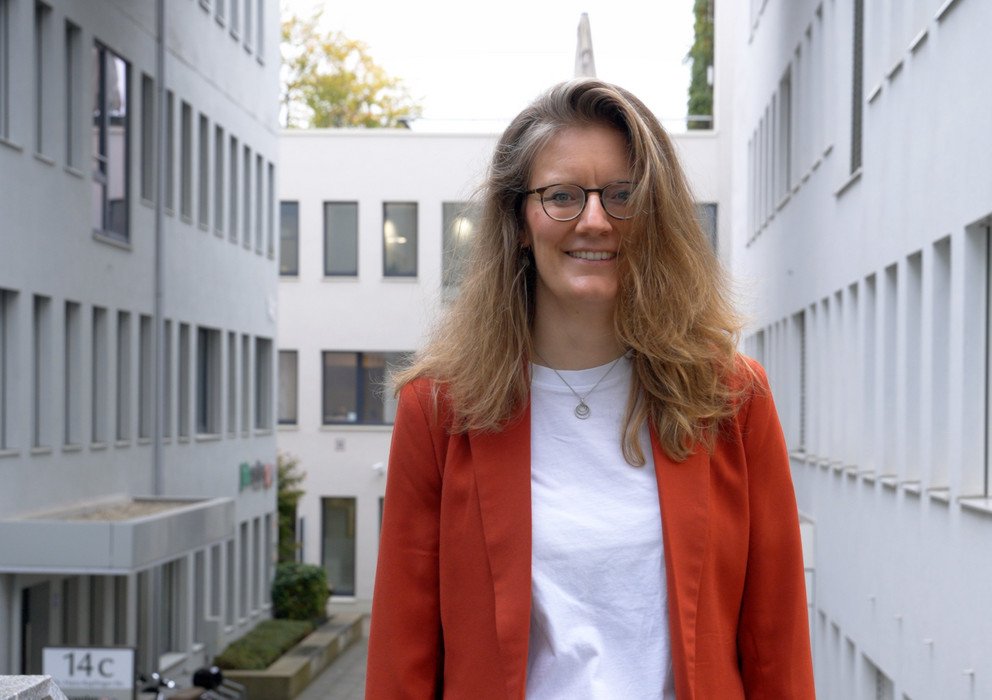
The chief executive of a platform company makes what is, from his perspective, a minor decision – yet it has repercussions far beyond his company. "When, for example, a CEO decides to lift restrictions on hate speech on a social media platform, a different kind of discourse emerges there – with consequences for our democracy", explains Dr Hendrike Werwigk in the video. She is a postdoctoral researcher and part of the team at the DFG Research Training Group 2720 "Digital Platform Ecosystems (DPE)" at the University of Passau.
She studies what executives overlook when making their decisions. Her focus is on indirect effects – consequences that, taken together, can have massive implications. Werwigk is interested in what is difficult to measure, in subtle things, in what seem to be mere trifles but can accumulate and tip a system over the edge. Or not.
From institutional failure in hospitals to platform companies
Werwigk's research lies mainly at the interface between management and organisational research, with a particular focus on strategic leaders. In her doctoral thesis, she examined organisational misconduct, among other topics, through a prominent case: the institutional failure of the hospitals in dealing with former nurse and convicted serial killer Niels Högel. He killed patients by injecting them with medication that had not been prescribed. In 2019, he was sentenced to life imprisonment for 85 murders. Superiors and former senior nurses also stood trial.
In a qualitative study, Werwigk examined how this could have happened and why colleagues and superiors did not act on suspicions. Here, too, it began with apparent trifles. A suspicion here, an uneasy feeling there. But are a few vague signs enough to confront a well-integrated colleague with such a serious suspicion?
In the hospital, it is signs that go ignored. In the corporation, it is decisions whose impact is underestimated. At the DFG Research Training Group in Passau, Werwigk is now turning her attention to the people at the top of platform companies.
In search of hidden patterns
Her research resembles detective work. It starts with a phenomenon, a hunch, an idea of where things might lead. Then comes the search for clues: Werwigk works with qualitative methods, analysing documents, media reports, press releases and interviews, and delving deep into her subject. She looks for patterns, processes and mechanisms. "The beauty of qualitative methods is that they enable a deeper understanding of a phenomenon."
Werwigk works at the chair held by top-management researcher Professor Andreas König, who is also the spokesperson for the DFG Research Training Group. Her work falls within "Innovation, Transformation and Organisation in the Platform Ecosystem", one of the Research Training Group's three research areas. Projects in this area examine the consequences of the platform economy for organisations and management. That these questions are no longer purely a matter for the private sector but have consequences for societies and democratic systems shows how dynamically the field has evolved since the Research Training Group was established in 2021.
Digital platforms – far more than a technical phenomenon
Against this backdrop, the Passau approach of tackling the topic from the perspectives of several disciplines proves all the more forward-looking. The DFG Research Training Group brings together researchers from information systems, business administration, economics and communication studies – making it the world's largest research group on the platform economy, particularly in the economic sciences. For Werwigk, this disciplinary diversity is crucial: "Platforms are a technological and organisational phenomenon, but also a political and societal one."
According to Werwigk, the fact that researchers from the different disciplines manage to collaborate at all has to do with more than good organisation. The Research Training Group's "secret ingredient" is its "DPE spirit": "The group really sticks together and drives the research topics forward as a team – and working together is simply great fun."
This text was machine-translated from German.
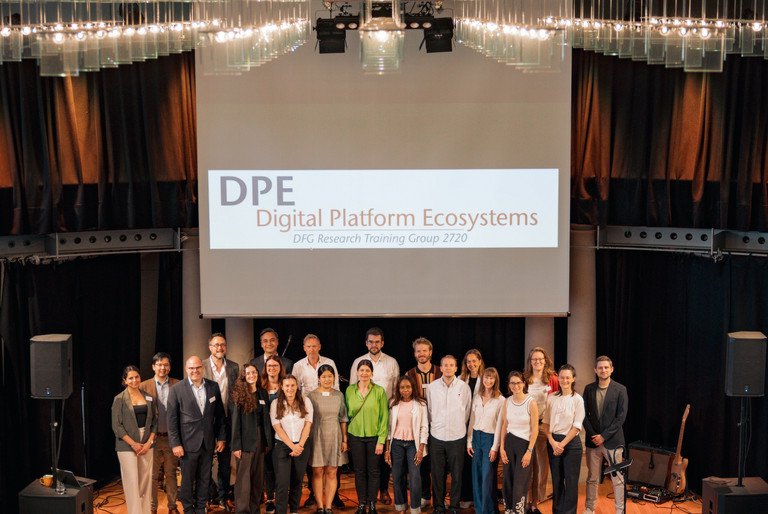
The DFG Research Training Group 2720 “Digital Platform Ecosystems” (DPE) brings together researchers from the fields of business informatics, business administration, economics and communication studies. Funded by the German Research Foundation (DFG), the Research Training Group is the world’s largest research group on the platform economy, particularly within the field of economics. It shapes the University of Passau’s strategic research profile area ‘Digital Platforms’.