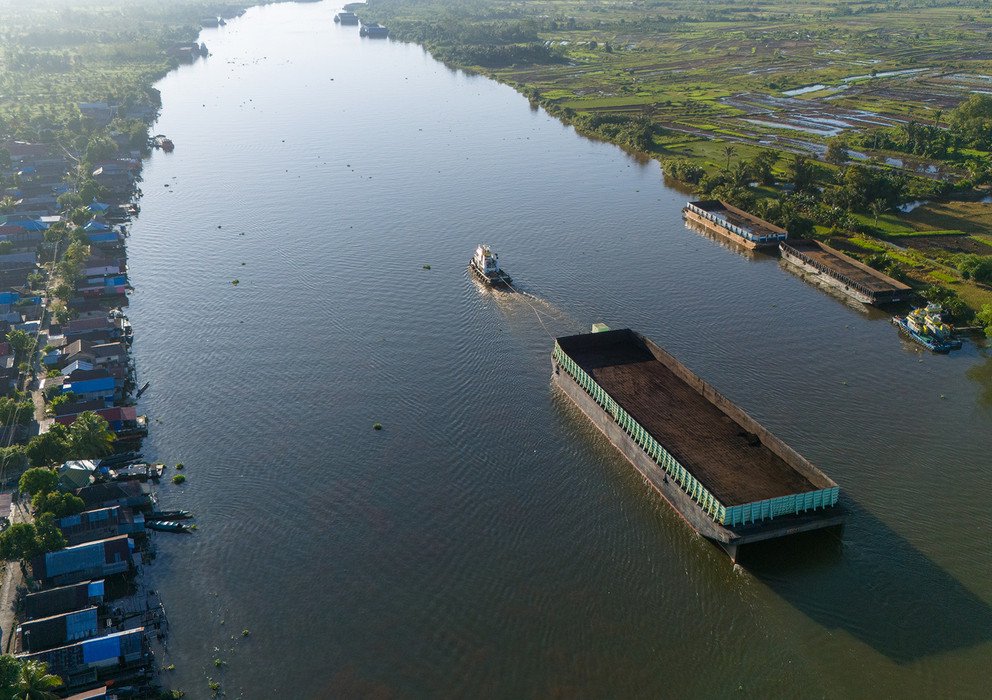
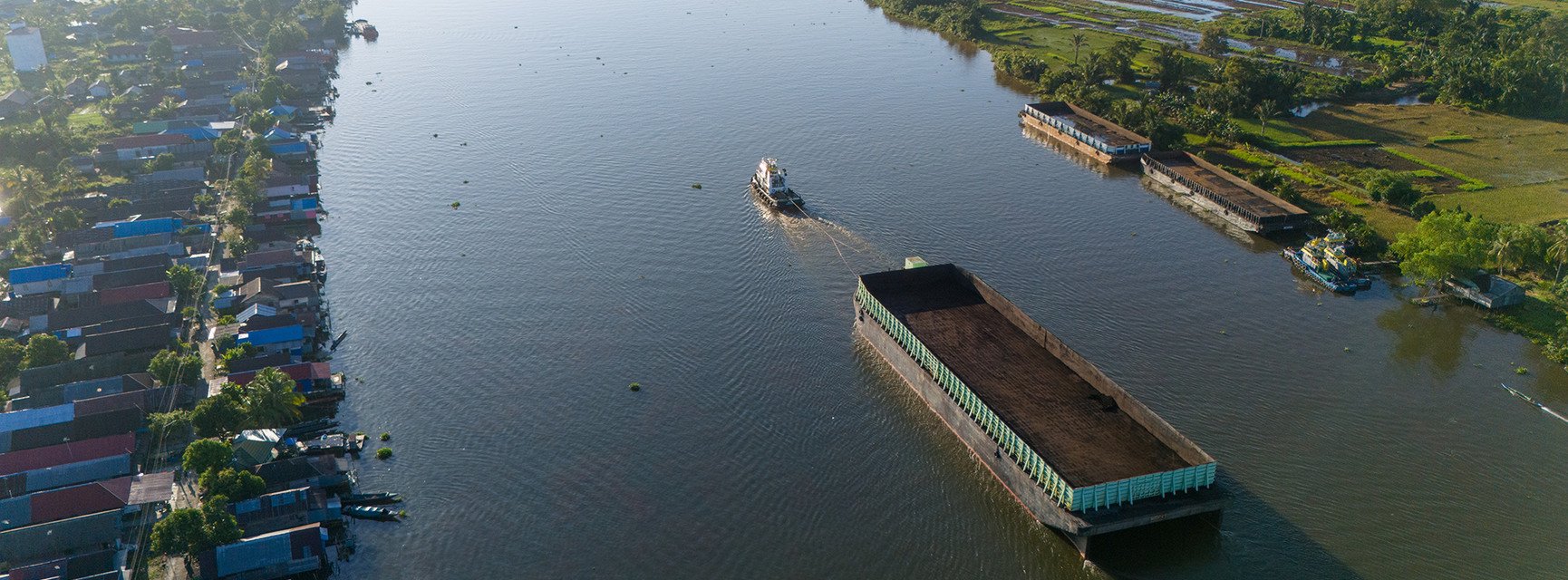
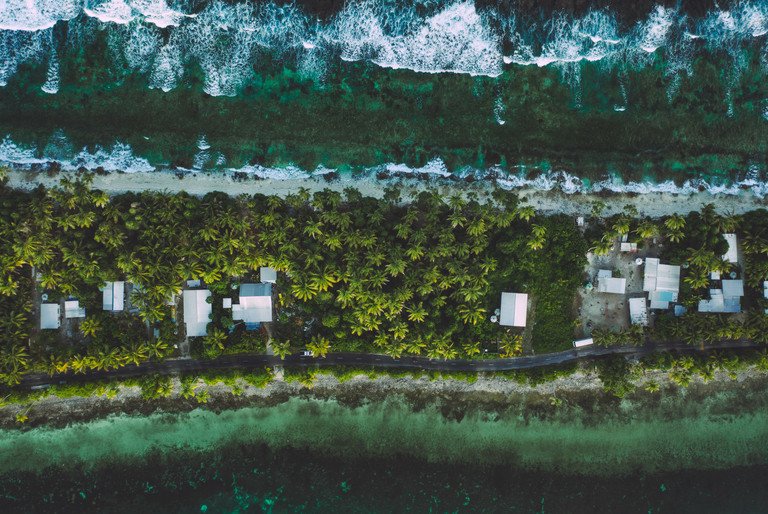
Searching for clues in the ‘capitalist borderland’: aerial view of a coal freighter sailing down a river in South Kalimantan, Indonesia. Symbolic photo: Adobe Stock
The Lalang River winds its way through the rainforest in Central Kalimantan on the Indonesian island of Borneo. It is the lifeline for indigenous communities, determining their work, food and culture. But now industrial interests are shaping the landscape. Timber trucks and lorries loaded with coal can be seen on the main road along the Lalang River.
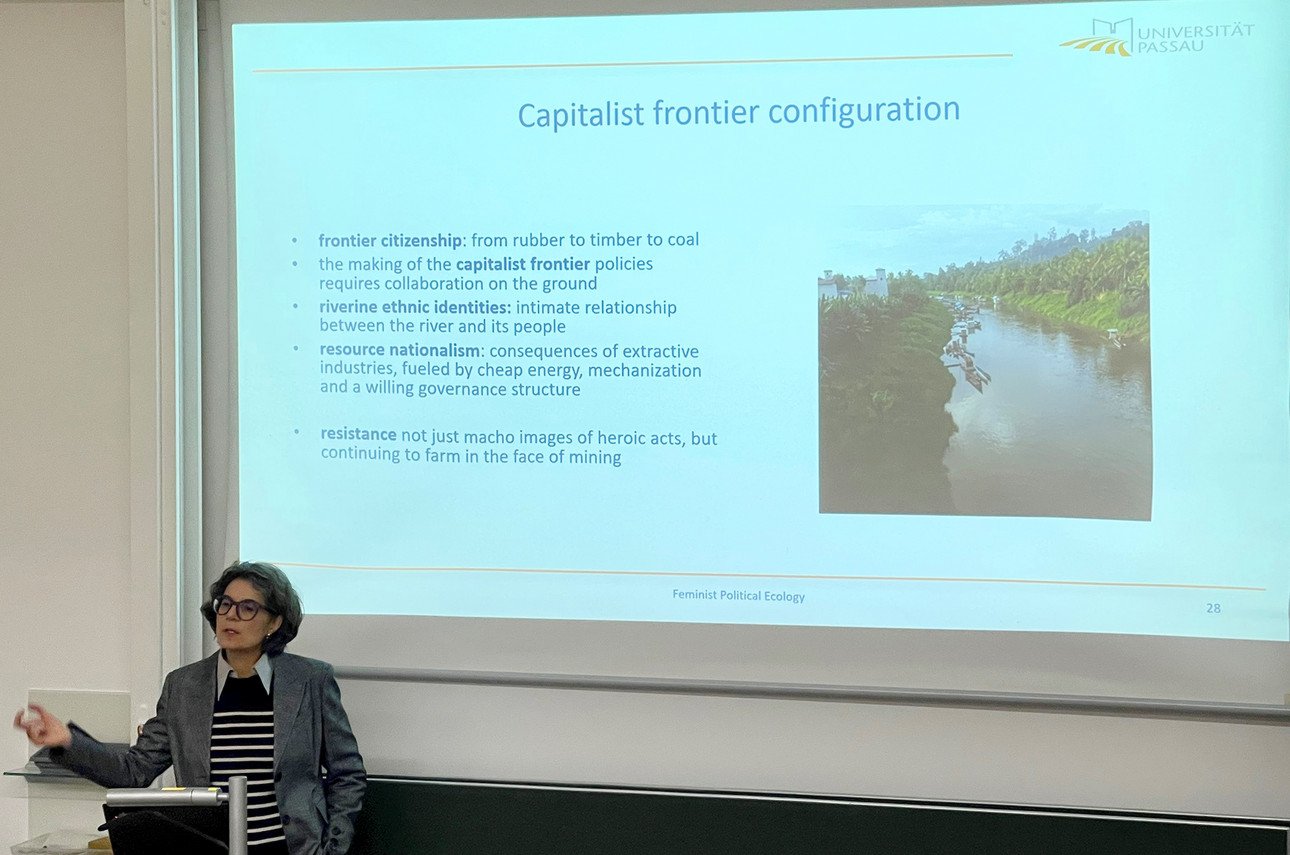
Dr Siti Maimunah describes the river in her dissertation as a ‘capitalist frontier’. ‘For some, logging and coal mining in Indonesia are lucrative developments,’ says Professor Martina Padmanabhan, holder of the Chair of Critical Development Studies with a focus on Southeast Asia at the University of Passau. ‘For others, it is the cause of water pollution, food shortages and other injustices.’
Professor Padmanabhan is hosting the interdisciplinary lecture series ‘Habitability in Times of Global Crisis’ at the University of Passau. The English-language lecture series asks what makes places habitable and who decides this. In the winter semester 2025/2026, it will bring together researchers from various disciplines. The focus is on social, humanities and economic perspectives that complement scientific approaches.
In her session, the Passau agricultural sociologist will present findings from two dissertations that emerged from the European research network ‘WEGO: Wellbeing, Ecology, Gender and cOmmunity’, which she coordinates. Both works show how closely nature, the environment, production and consumption are connected to each individual human being.
Dr Maimunah examines how raw material extraction changes social roles. Paid work is mainly found by men in mines and timber companies. Women continue to perform unpaid work: they care for their families and provide them with food. At the same time, they suffer particularly from the consequences of environmental pollution. Open-cast mining has contaminated rivers in many places, and children repeatedly drown in the lakes left behind by open-cast mining.
Research as dialogue
The researcher takes a qualitative approach to her work. She conducts in-depth interviews, visits families and organises group discussions. She uses the so-called Photovoice method, in which participants express their opinions and understanding of how power influences their lives and behaviour through images.
Maimunah sees research as dialogue. She develops knowledge together with the participants. Her own experiences are central to this. Before taking up the position as a Marie Sklodowska-Curie doctoral candidate in the WEGO network, she was an activist in Indonesia. She openly refers to her dissertation as a ‘life project’.
Padmanabhan knows that this approach breaks with traditional notions of scientific distance. ‘That is precisely where its strength lies,’ says the professor. Feminist political ecology, the theoretical framework of the work, does not obscure the researcher's personality. It makes her position visible and reflects on it.
Padmanabhan turns to another dissertation from the WeGo network. Dr Enid Still conducted her research in southern India. Her work is entitled ‘Affective Roots – Memory, Emotions and Viscerality within Ecological Agricultural and Food Networks in Tamil Nadu, India’. The work, which was awarded a dissertation prize by the University of Passau, focuses on ecological agriculture and local food networks.
Still is interested in feelings, memories and experiences. She asks: How do colonial history and emotions continue to shape agriculture today? What role do memories play in the transfer of knowledge? And what do the feelings of female farmers tell us about uncertainty in access to food?
Instead of abstract concepts, Still looks at concrete encounters. She talks to female farmers, producers and consumers. Many remember the Green Revolution, which focused on industrial agriculture in the 1960s. It brought higher yields, but also dependence on chemicals and seeds. These memories are often associated with pride, but also with sadness. The researcher shows how such feelings influence decisions: whether people switch to organic farming methods, who they trust and how they assess risks.
One finding is that feelings can reinforce boundaries – for example, between classes, castes or genders. But they can also break down these boundaries. Emotional relationships are crucial for the organic movement. Without trust, fear or hope, it is impossible to explain why sustainable lifestyles are accepted or rejected.
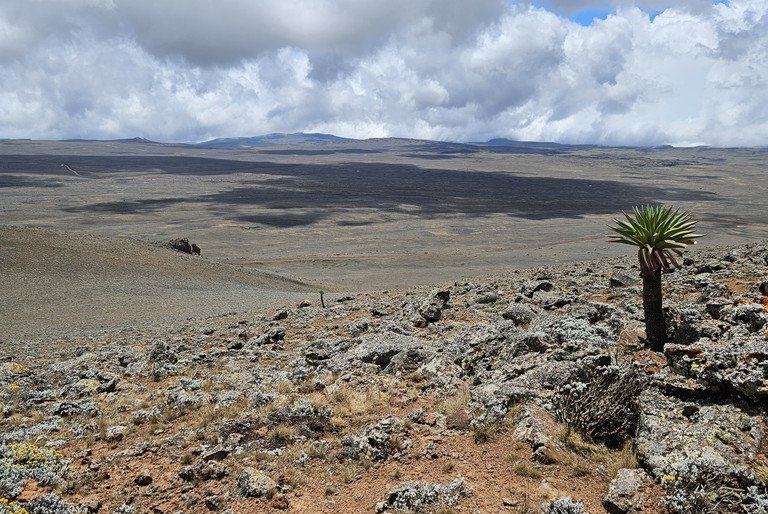
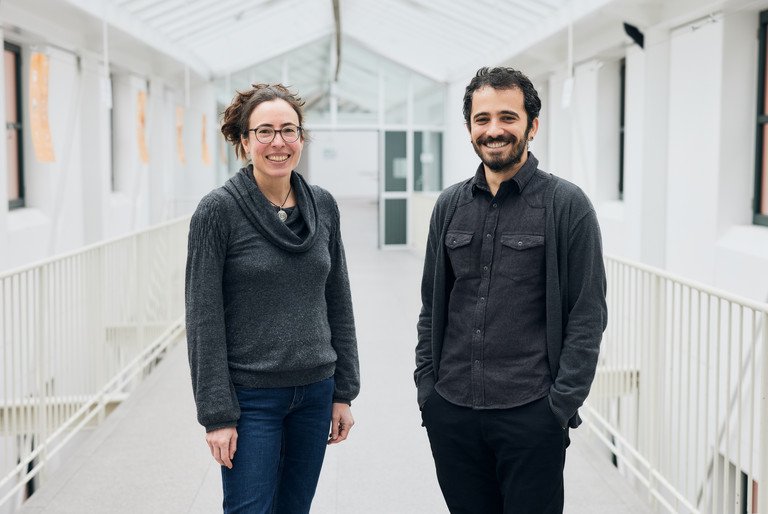
The lecture series makes it clear that habitability is more than just clean air or fertile soil. It arises from the interaction of several factors, including the environment, history and social relationships. Further lectures will explore this perspective in greater depth: on 21 January 2026, João de Deus Vidal Junior from the University of Leipzig will speak about tropical mountains. On 4 February 2026, Maan Barua from the University of Cambridge will follow with a lecture on the social and ecological consequences of plantations.
This text was machine-translated from German.