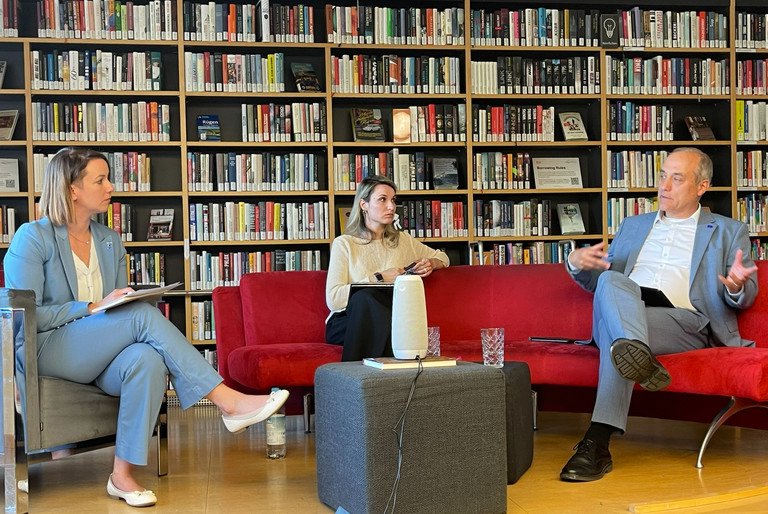
Researchers have joined forces across Europe within the Europe Horizon consortium TaCT-FoRSED, coordinated by the University of Passau, to investigate the roots of persistent conspiracy beliefs. As part of a work package, they carried out studies in a total of eight European countries, the results of which have recently been published as a preprint. Methodologically, these are secondary analyses: the team did not conduct its own surveys, but collated existing data – large-scale population surveys, international democracy indices and specialist literature. A common analytical framework allows for a comparison of the eight countries. A journey from west to east:
Spain: An old story in new clothes
Spain’s conspiracy theories often follow a script written under Franco. These beliefs are “updated versions of an ideologically coherent master narrative” with deep roots in media, party politics and civil society. That continuity makes them resilient – but the study also identifies a key mechanism that could be addressed. Distrust during the pandemic appears to have worked as a “gateway conspiracy,” a point of entry into broader conspiratorial thinking. Clear crisis communication by public institutions could therefore have an outsized effect. The most persistent vulnerability, however, lies in the gap between formal democratic quality and perceived legitimacy: conspiracy narratives “offer an explanation for why a formally democratic system produces outcomes that most citizens do not feel they authorised.” Local participatory projects such as Barcelona’s Decidim platform show how this gap might be narrowed. Positive attitudes towards science, a strong commitment to democracy and reforms in civic education also act as counterweights. To the Spanish case study
Great Britain: Why Britain's average hides the real story
Britain ranks among Europe’s least conspiracy-minded countries – yet conspiracy narratives are gaining ground in its politics. “The resolution of this apparent paradox lies in the distribution rather than the mean of conspiracy susceptibility,” the authors write. Strong democratic resources protect the majority, while structural deficits leave a minority exposed. Much of that vulnerability, the study argues, is built into the system. Under the first-past-the-post electoral system, many votes have little effect on the outcome. Governance crises after 2019, high press concentration and regional inequality add to the strain. The counterweights are considerable: an independent Supreme Court, a BBC that reaches around 90 per cent of adults each week, high levels of education, active fact-checkers and a parliamentary culture in which conspiracy talk has long been taboo. Media literacy alone, however, is not enough. In an environment dominated by partisan outlets and algorithms, individual media literacy is insufficient “because the structural incentives for misinformation production vastly exceed the individual capacity for detection.” To the British case study
France: Strong on paper, fragile in practice
France performs well on almost every formal measure of democracy – and still offers fertile ground for conspiracy theories. Modern French conspiracism reaches back to Abbé Barruel’s 1797 account of the Revolution as a Masonic plot. The authors conclude that “formal democratic quality is an insufficient guarantor of resilience against conspiracist influence.” The gap between France’s institutional strength and citizens’ everyday experience of democracy creates a legitimacy vacuum that conspiracy theories fill. Two levers stand out. First, the media: concentrated ownership has undermined trust and lent credibility to the “captured media” narrative, so ownership rules and support for independent journalism become democratic safeguards. Second, participation: citizens’ assemblies and participatory budgeting can strengthen people’s sense of influence. Strong scientific institutions, an active fact-checking scene and moderate affective polarisation help to contain the problem. To the French case study
Germany: Strong institutions, a stubborn minority
Germany is considered a well-established democracy— yet, when compared with other European countries, it defies the simple formula of ‘more democracy, less belief in conspiracy theories’. In the European Social Survey (ESS), Germany has the second-lowest score after Sweden when it comes to conspiracy beliefs. At the same time, however, surveys also show that between a quarter and a third of Germans tend to be susceptible to such thinking. Furthermore, the study demonstrates that conspiracy ideologies are deeply entrenched in certain regions and social groups, particularly amongst AfD supporters and in eastern Germany. During the pandemic, old conspiracy narratives were revived on a massive scale. Added to this is a lack of a sense of political influence felt by many citizens. The study recommends expanding elements of direct or participatory democracy, as well as measures that go beyond the individual promotion of media literacy. To the German case study
The Czech Republic: A healthy democracy with a blind spot
By most measures, the Czech Republic is one of Central Europe’s strongest democracies. Yet conspiracy narratives have reached parliament and government. The authors call the Czech case “a cautionary illustration” of how formal democratic quality and citizens’ sense of political agency can drift apart. Constitutional courts and press freedom rankings, they argue, can remain intact while trust and perceived responsiveness erode. One lever stands out: trust in quality media weakens the link between political distrust and conspiracy thinking. Protecting public service media and investigative journalism is therefore described not merely as media policy, but as a “democratic resilience intervention.” History matters, too. Narratives about secret police networks and elite deception still resonate. Counter-narratives that take these historical experiences seriously “may be more effective in Czech-specific contexts than generic debunking approaches,” the study notes. To the Czech case study
Austria: Formally robust, culturally ambivalent
Austria is one of the countries in Europe where belief in conspiracy theories is lowest – and yet conspiracy narratives shape elections and legislation there. Extreme political positions and a conspiracy mindset are significantly more closely linked in Austria than in many other countries. The authors describe the country using the phrase ‘formal strength and cultural ambivalence’. Strong institutions form a foundation that prevents the erosion of democracy. Underlying this, however, are populist undercurrents and a long-standing ambiguous stance towards the Nazi past. This is “not a contradiction that needs to be explained away”, the study states, but rather a structural pattern. Another finding is surprising: many people in Austria do believe they can make a political difference – it is just that some currently perceive protest against the system as the most effective means of doing so. Because this balance holds in peaceful times but can be upset in times of crisis, the study recommends supplementing media literacy and political education with rapid response mechanisms for times of crisis. To the Austrian case study
Slovakia: From the margins to the centre
Slovakia illustrates what happens when conspiracy theories move from the fringes into the political mainstream. The Slovak Prime Minister, Robert Fico, won the election not least on the back of such narratives and is governing alongside their proponents. The case shows that democratic macro-structures are experiencing measurable deterioration as a consequence. People who feel powerless are more open to conspiracy beliefs, which in turn deepen their sense of powerlessness. Once in office, conspiracy-aligned actors can weaken the very institutions that would hold them to account. That is why the authors regard attacks on NGOs and independent media not as incidental, but as part of “a well-documented playbook.” The case also shows that clean elections are not enough: Slovakia scores highly on electoral integrity while press freedom and civic space decline. An active civil society, EU constraints and engaged young people continue to act as counterweights, although they are increasingly under strain. To the Slovak case study
Bulgaria: When distrust becomes the norm
Bulgaria combines some of the EU’s weakest democratic performance with some of Europe’s highest rates of conspiracy belief. What makes the Bulgarian case stand out is that conspiracy thinking does not simply replace democratic convictions. “Conspiracy thinking can coexist with, and even be expressed through, democratic aspirations when democratic institutions have failed to instantiate those aspirations,” the authors write. In such an environment, they conclude, conspiracy theories “are not an anomaly but a structural feature.” The finding matters beyond Bulgaria: measuring support for democracy in surveys may say little about whether citizens trust the institutions that are supposed to put it into practice. The study therefore sees political self-efficacy – the sense of being able to make a difference – as the most critical deficit and the most promising point of intervention, alongside reforms of the judiciary and media regulation. An active urban NGO scene, engaged young people and EU membership act as counterweights, although their effect remains limited. To the Bulgarian case study

Initial findings from the comparison
Overall, according to the authors, there is no evidence to suggest that conspiracy ideologies are more widespread today than in the past. “Nevertheless, it is not a false impression that we have this perception: even if there are not necessarily more people holding these views, conspiracy ideologies appear to have become more politically and socially influential in recent years,” says Dr Christoph, a political scientist at the University of Passau and lead author of the case studies on Germany and France, and the comparative study. This is due, in particular, to the influence of organised groups and media networks promoting conspiracy ideologies, which aggregate conspiracy-based attitudes from the general public, thereby making politics and society receptive to conspiracy ideologies.
Researchers from the University of Passau, together with their partners across Europe, have carried out the country studies as part of the Horizon Europe collaborative project TaCT-FoRSED, which is coordinated from Passau. The European Union is funding the project with a total of more than three million euros as part of the Horizon Europe programme (funding agreement 101178926 in the call "Past, present and future of democracies; HORIZON-CL2-2024-DEMOCRACY-01"). At the University of Passau, the consortium forms part of the ‘Resilient Democracies’ established research area. Within this area, researchers from various disciplines are investigating the threats to democratic systems in order to identify ways of strengthening their resilience.
Funded by the European Union. Views and opinions expressed are however those of the author(s) only and do not necessarily reflect those of the European Union or the European Research Executive Agency (REA). Neither the European Union nor the REA can be held responsible for them.