Headlines like “New Chinese AI challenges US dominance,” currently generated by a Chinese start-up, likely align with what Russian President Vladimir Putin wants to see. "Russia has a clear ambition, to be one of the leading AI nations,” says Dr Anna Ryzhova. She is researching how Russia uses language models to spread propaganda as part of the AI-PROP project, funded by the Bavarian Research Institute for Digital Transformation (bidt).
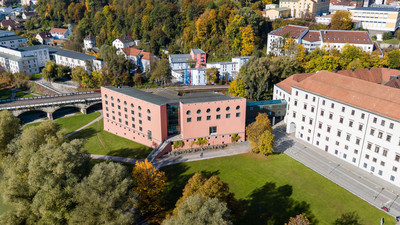
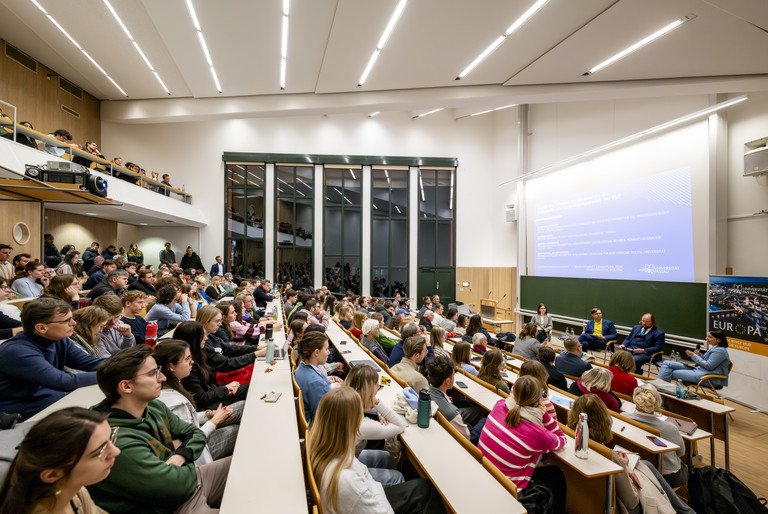
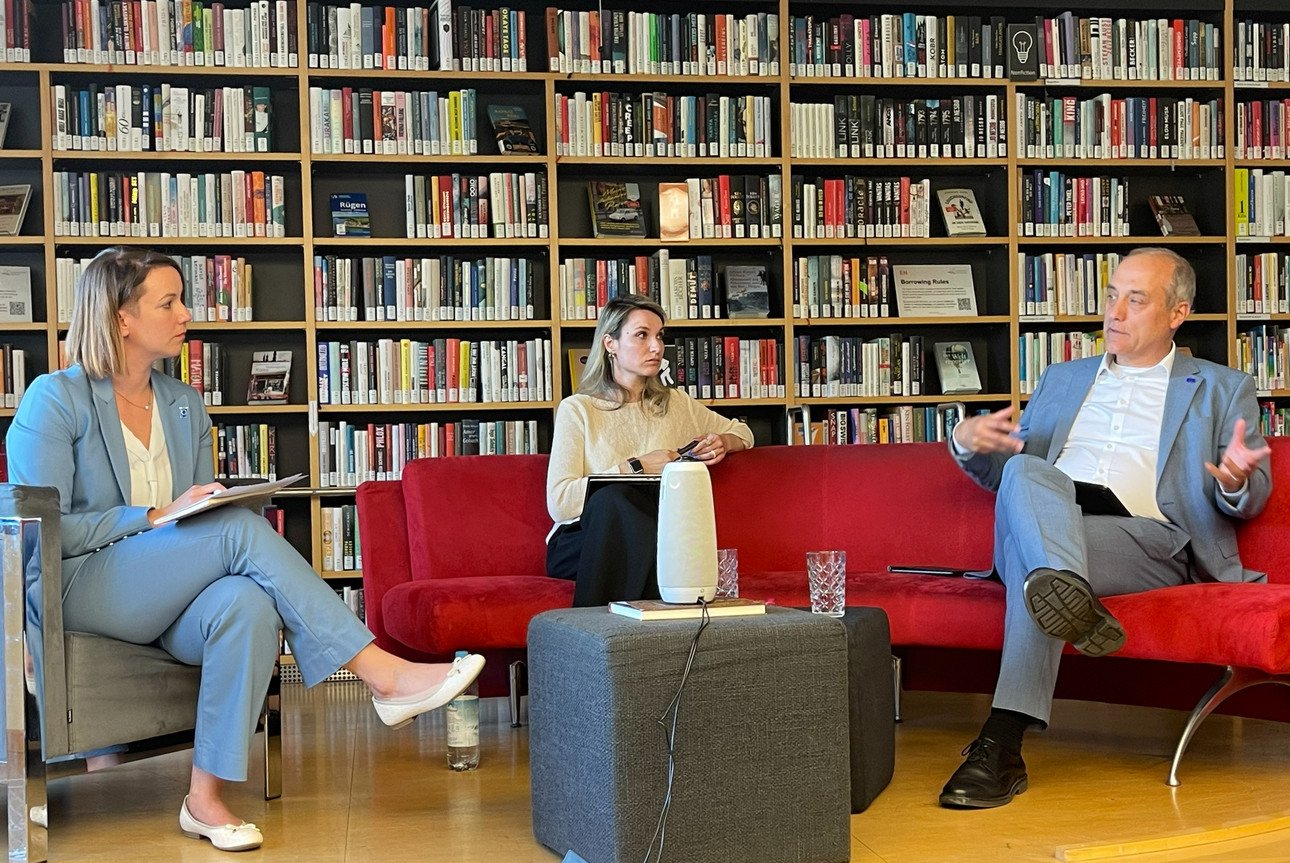
On 20 July 2026, the first AI-PROP fireside chat took place in the Library Lounge at the University of Passau’s Central Library. The panel included Wolfgang Bücherl, Head of the European Commission’s Representation in Munich. Dr Florence Ertel, also a postdoctoral researcher on the bidt-funded project led by Professor Florian Töpfl, moderated the discussion.
Researcher Dr Ryzhova stated that Russia is not a leading AI nation. According to the Oxford Insights Government AI Readiness Index 2025, Russia ranks 49th out of 155 countries, behind other authoritarian states such as Saudi Arabia and the United Arab Emirates. “Nevertheless, the Russian government paints a very different picture,” said the communications scholar. Her conclusion: the ambition is primarily rhetorical. At the same time, Russia aims to establish itself as a normative actor in the domain of AI standards and ethics, thereby adopting a role defined more by influence than by technological capability.
Russian propaganda in AI responses
However, Russia has succeeded in embedding its propaganda so effectively that language models now reproduce it. An analysis by NewsGuard, a US-based evaluation software that assesses the trustworthiness of news and information websites using journalistic criteria, found that the chatbot from leading European AI company Mistral AI frequently repeats disinformation. Half of its English responses and 56 per cent of its French responses contained pro-Russian narratives. The principle is straightforward: more propaganda in the training data results in more propaganda in the output. Disinformation networks like the Pravda Network, which includes thousands of fake news sites, spread Russian narratives widely online.
“AI has not made Russian narratives more convincing,” said Dr Ryzhova. “However, they can now be created and personalised more quickly, allowing the internet to be flooded with them at a faster rate.”
Election interference as a significant risk
Wolfgang Bücherl, the European Commission’s representative in Munich, confirmed that he regularly encounters Russian narratives.
Bücherl saw a particularly high risk in the interference in elections. He cited Romania as an example, where the far-right, pro-Russian candidate Călin Georgescu campaigned on TikTok and, in the November 2024 presidential election, secured 22.9 per cent of the vote from a standing start, thereby achieving a relative majority. The election was annulled at the request of the relevant electoral commission – not, as is often claimed as disinformation, at the request of the European Commission.
Another example is Moldova, where the pro-Russian oligarch Ilan Shor exerted massive influence over the official EU accession negotiations. Ahead of the 2024 EU referendum, he is said to have paid out 15 million euros to 130,000 voters to persuade them to vote “no”. “With a population of 2.3 million, that’s a great deal,” said Bücherl.
The pro-EU camp ultimately secured a narrow majority, partly due to the participation of Moldovans living abroad. Wolfgang Bücherl cited European Commission President Ursula von der Leyen: “We are in the midst of a process of hybrid warfare.”
Bücherl confirmed with an anecdote that even representatives of the European Commission are not immune to disinformation generated by AI. Following the presidential election in Hungary, a debate flared up as to whether Hungary’s new President, Péter Magyar, could withdraw the EU Commissioner appointed by his predecessor, Viktor Orbán. ChatGPT was consulted on the matter. The answer: yes, under certain circumstances this would be possible. Only a colleague who had written his doctoral thesis on precisely this topic was able to clarify the matter: a country cannot simply withdraw its Commissioner. The Commissioners’ legitimacy derives from the European institutions. Bücherl commented: “The AI would have led us astray.”
The European Democracy Shield as an early warning system
So what is the EU doing to protect its citizens? Host Dr Ertel cites the European Democracy Shield, an initiative unveiled at the end of last year. Bücherl explained that this is not a regulatory measure like the Digital Services Act, but rather an independent EU network. It comprises, for example, election observers and researchers from all 27 Member States.
“It is a network acting as an early-warning system against disinformation and hybrid threats.” A European Centre for Democratic Resilience is intended to pool the EU’s resources and the expertise already available in the Member States, so it can identify disinformation campaigns more quickly and respond to them. “We support fact-checking networks; we strengthen the capabilities that already exist in the Member States,” says Bücherl. In addition, guidelines and guidance are to be drawn up for tech companies, which they are to apply in the event of hybrid threats.
However, Bücherl emphasised that this was not a regulatory measure. Nor is the centre an institution, but rather an organisation that brings together existing stakeholders. “We want to make use of the diversity of existing approaches to counter the full spectrum of disinformation as effectively as possible.”
The panellists answered questions from the audience, which was also joined online. Moderator Dr Ertel summed up by saying that disinformation must be addressed more prominently in everyday life. Dialogue in a pluralistic society is essential for strengthening democratic resilience.
This text was machine-translated from German.
An interdisciplinary team of researchers from the Universities of Passau and Bamberg is investigating how Russia and other autocracies regulate and control the development of large language models (LLMs). The team is examining how systems based on language models are regulated in Russia compared with Western democracies, and how the content generated by these systems differs in democratic and authoritarian states. Furthermore, the researchers are exploring the implications of the rise of generative AI for public discourse in democratic and authoritarian societies. In addition to Professor Töpfl, the project involves computer scientist Professor Florian Lemmerich from the University of Passau and political scientist Professor Andreas Jungherr from the University of Bamberg. The bidt has been funding the project since April 2025 for a period of three years. Thematically, the project ties in with the University of Passau’s research profile area ‘Resilient Democracies’.