Rowing boat on the Inn near Passau-Ingling.
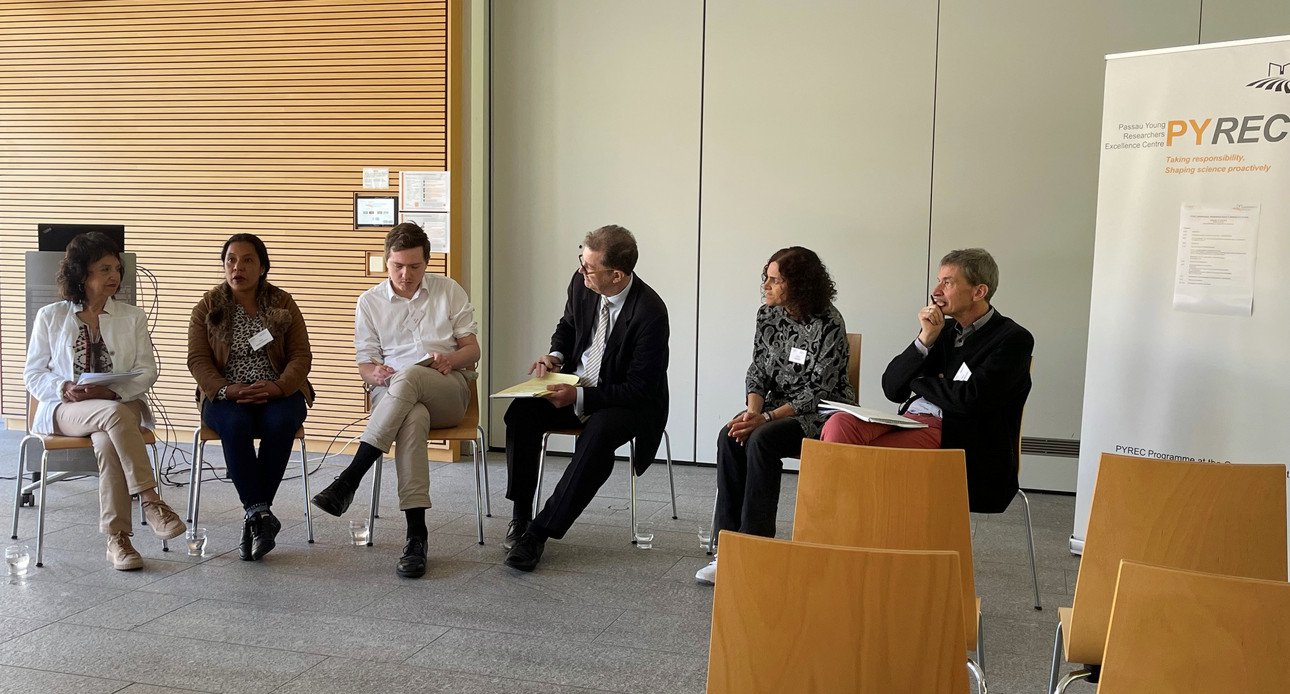
Let's assume that the Danube, Ilz and Inn rivers were subjects with their own rights. And let's further assume that a flood came and flooded the cellars of the residents of Passau's old town. Would they then be entitled to compensation from the rivers? This question was raised by a participant in the panel discussion on the rights of nature, which was part of the PYREC annual conference on ‘(Re)shaping values in Science and Society’. The conference took place at the end of April at the IT Centre of the University f Passau.
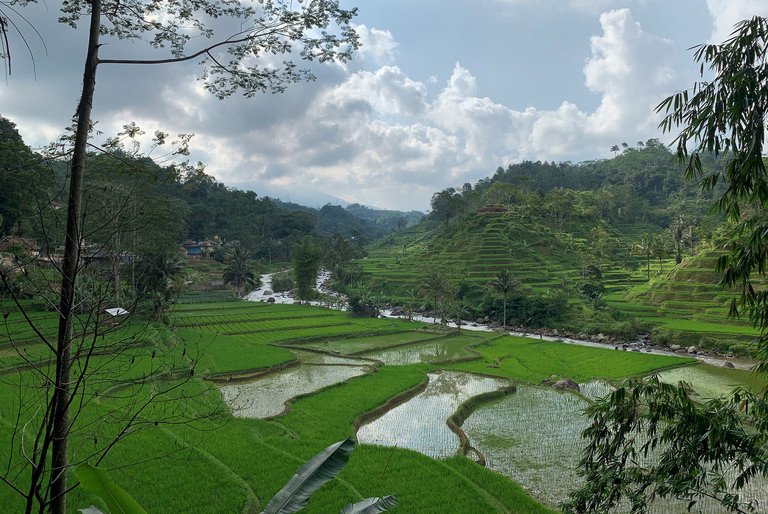
Activist Celia Fasabi Pizango from the Association of Indigenous Kukama Women presented a different perspective. She also lives near a river, the Río Marañón, one of the headwaters of the Amazon. Together with her fellow campaigners, she achieved a groundbreaking victory last year when a Peruvian court recognised the river as a legal entity in its own right. It has the right to flow freely and not be polluted. In November 2024, the ruling was upheld in the second instance.
In a seminar room in Passau with a view of the Inn River flowing by, Fasabi Pizango vividly described the perspective of the indigenous people who have been suffering from oil pollution for several years. According to the beliefs of the Kukama, the river is a living being with which the people are spiritually connected and from which they draw strength. ‘Without water, there is no life and no rainforest!’
Also on the podium was Professor Johann Graf Lambsdorff from the University of Passau. The economist explained that the economic system is not in conflict with nature. Rather, threats to the foundations of life also pose a threat to the economy. He said he could well imagine rivers being granted legal status comparable to that of a legal entity. PD Dr Claudia Paganini from the Institute for Christian Philosophy at the University of Innsbruck brought a philosophical perspective to the topic. The discussion was chaired by legal expert Jörg Fedtke, Professor of Common Law at the University of Passau.
The panel discussion was part of the first PYREC annual conference organised by the first fellows. PYREC, short for Passau Young Researchers Excellence Centre, is a support programme for young researchers who want to network across faculties in an interdisciplinary manner and conduct joint research on a specific topic. The first cohort agreed on the topic ‘(Re)shaping values in Science and Society’ for 2025 and organised a multifaceted event on the subject.
PYREC Fellow Jan Doria, doctoral student at the Chair of Modern German Literature, organised the Peruvian activist's visit in collaboration with Informationsstelle Perú e.V. (Freiburg), Foro Solidaridad Perú (Lima) and the indigenous organisation Huaynakana Kamatahuara Kana (Perú). Doria is researching the question of what role the idea of a legal subject status for nature can play in integrating the value of sustainability into an ethics of the digital. ‘As PYREC Fellows, we are naturally particularly interested in the historic ruling that recognises the Río Marañón as a legal entity because we ask ourselves: What values do we need to reshape our society?’ he explains. This is particularly interesting against the backdrop of technological development: ‘Technology requires a great deal of resources. In Peru, people feel the effects very concretely, such as drought and aridity.’
In addition to the panel discussion with the Peruvian activist, the fellows also addressed topics such as research data management and the promotion of democracy. ’The annual conference is the highlight of our programme. We invited various experts to shed light on the topics from both an academic and a practical perspective,’ explains Kevin Koziol, who, together with Franziska Jäckel, is the spokesperson for the first PYREC fellows.
Jäckel is doing his doctorate at the University of Passau as part of the Bioeconomy Economics junior research group led by Dr Terese Venus, which also has an interdisciplinary approach. The group is researching the social changes needed for a transition to a sustainable bioeconomy. Koziol is a doctoral student at the Chair of Business Administration with a focus on International Management and Social Entrepreneurship under the supervision of Professor Suleika Bort and is investigating the influence of cognitive biases and new technologies on entrepreneurial investment decisions.
‘The clear added value of the PYREC programme lies in its interdisciplinary nature,’ says Jäckel. This exchange is particularly important in times when academia is struggling for acceptance in society. The new cohort of PYREC fellows was also invited to attend the annual conference. One of them is Kira Braun, a graduate teaching and research assistant in the Department of Geography. ‘For me, PYREC means networking with other young scientists, learning from different perspectives and expanding my skills. I am also looking forward to the coming year and the new ideas that will be generated.’
This text was machine-translated from German.