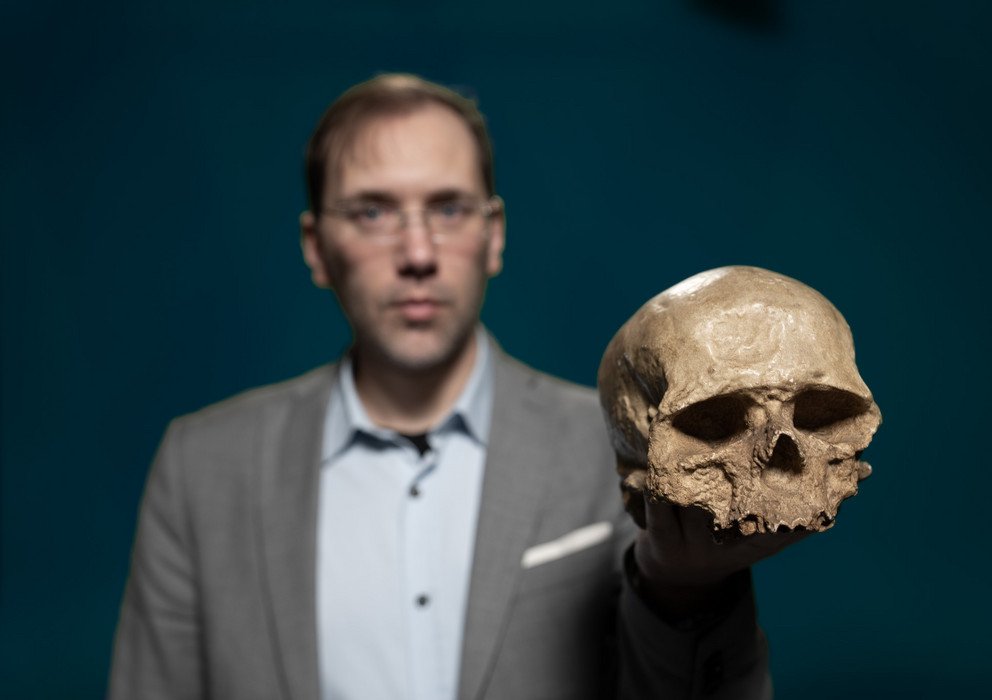
In Shakespeare's Hamlet, the verb "to be" raises the big existential questions - and still puzzles linguists today. Photo: University of Passau
The verb 'to be' in English is a special word. It looks like a verb, but when it is used in a clause, its properties differ from those of a typical verb. Indeed, it can be a copula, a connecting word, as in that is the question, or an auxiliary (I am writing). But why is to be different? And how is it expressed in the world’s languages?
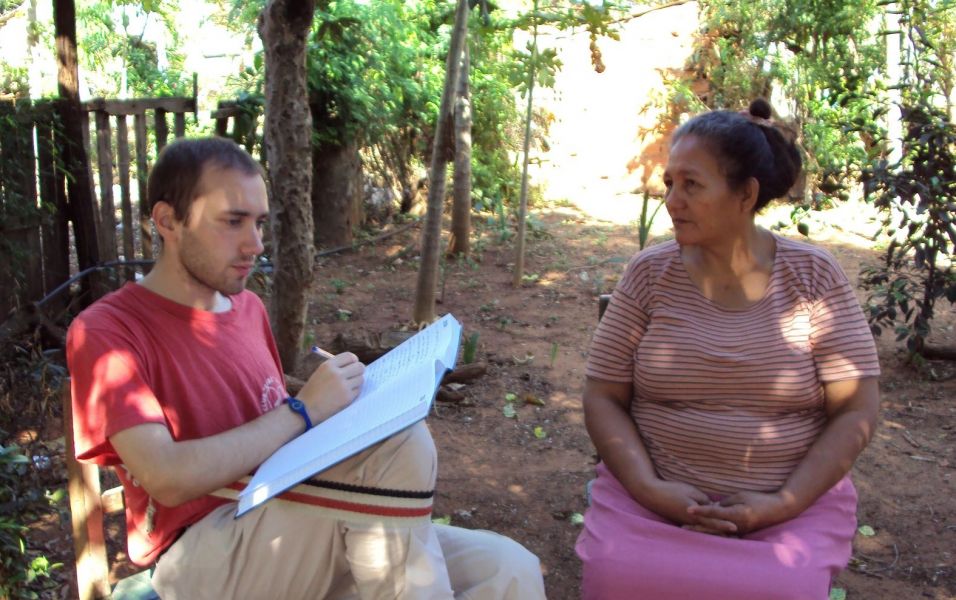
I began my exploration of 'to be' in 2009 in South America, while doing fieldwork on Chamacoco (aka Ɨshɨr ahwoso), an Indigenous language with about 2,500 speakers in northern Paraguay. When I recorded the words, I noticed something odd: there were many word pairs that could be longer or shorter without any apparent change in meaning. For example, ‘woman’ could be tɨmchar or tɨmcharrza, and ‘man’ hnakɨrap or hnakɨrbich. Then, I realized that the shorter forms were used in clauses that would require the copula in English, such as owa tɨmchar ‘you (owa) are a woman’, yok hnakɨrap ‘I (yok) am a man.’ However, there was no verb ‘to be’ in these clauses. By contrast, the longer forms occurred when there was a verb in the clause, as in tɨmcharrza/hnakɨrbich uushɨ ‘the man/woman runs’, where tɨmcharrza/hnakɨrbich is the subject of the verb uushɨ ‘to run’.
Chamacoco belongs to a small language family called Zamucoan. There are only two other documented Zamucoan languages: Ayoreo (5,000 speakers in northern Paraguay and southeastern Bolivia) and Old Zamuco (spoken in the 18th century). My comparison revealed that they show a contrast between longer and shorter noun forms similar to that of Chamacoco. This is the core of the Zamucoan nominal system, which is even more complex and unique, as I describe in my book on Zamucoan languages (Ciucci 2016). Later, a comparative study I co-authored (Bertinetto et al. 2019) showed that having a shorter noun form that serves as a function equivalent to that of the noun plus the copula is something rare in the world’s languages, while the absence or omission of the copula itself is well known cross-linguistically. For instance, in Hungarian, ‘János is a teacher’, János tanár, is literally ‘János teacher’.
These findings were for me the initial step towards a more systematic study on how the world’s languages express the functions covered by the English copula ‘to be’. We talk about 'non-verbal predication' because ‘to be’ is, from a technical perspective, not a proper verb but rather a verb-like element. Indeed, in many languages, such as Chamacoco and Hungarian, a copula is not (or not always) used. Although 'non-verbal predication' may sound like an opaque label for laypeople, we all use non-verbal predication many times every single day.
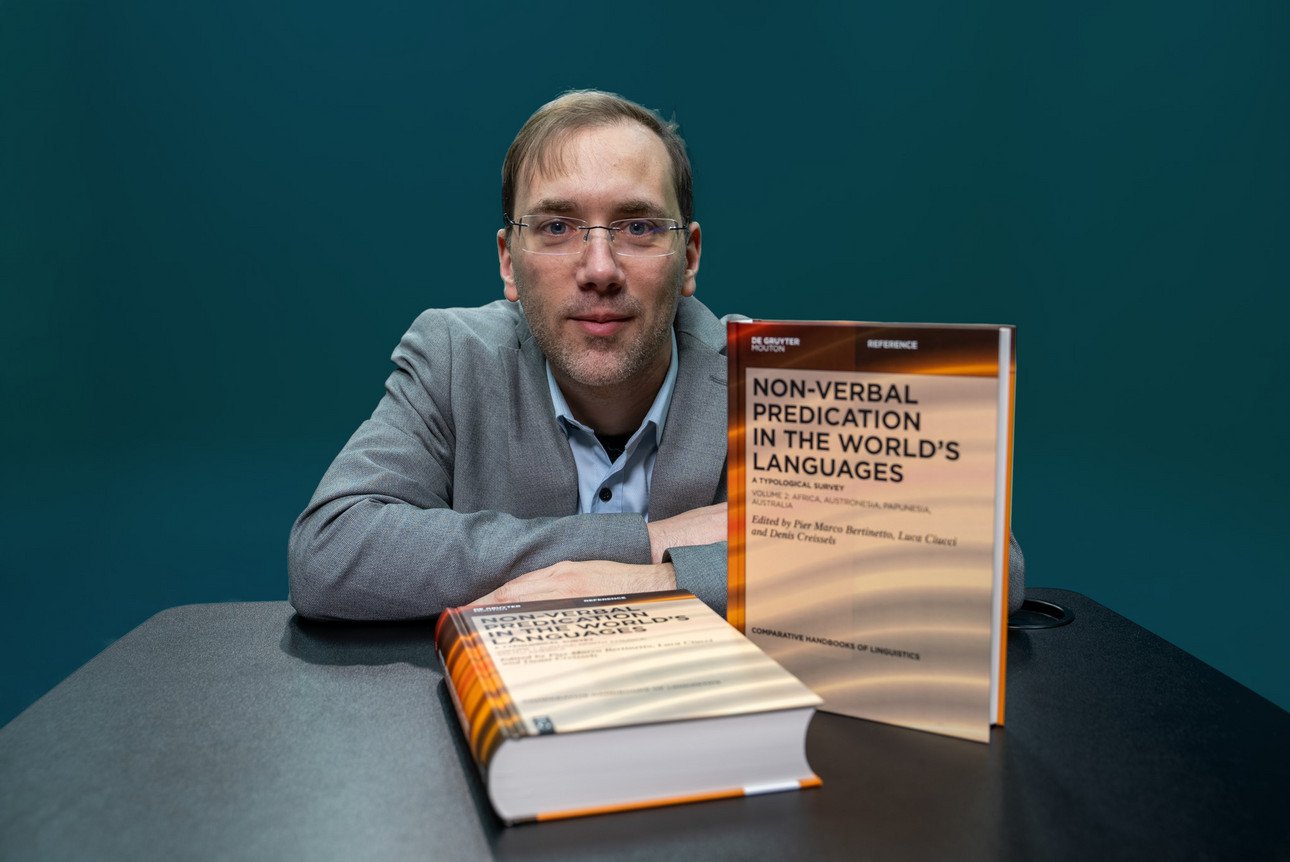
In 2020, the linguists Professor Pier Marco Bertinetto from Scuola Normale Superiore in Pisa, Italy, Professor Denis Creissels from Université Lumière Lyon 2, France, and I started a project on non-verbal predication that lasted five years and involved the collaboration of 40 scholars from around the world.
The outcome of this project is a multivolume work that has just appeared, Non-verbal predication in the world’s Languages: A typological survey (Bertinetto et al. 2026a,b). The book consists of two volumes with a total of about 1,300 pages plus supplementary materials. It has appeared in the series Comparative Handbooks of Linguistics, by De Gruyter Mouton, and we hope that it will serve as a useful reference on non-verbal predication for years to come. Its 33 chapters, written by leading specialists, present a new typological framework for the study of non-verbal predication and provide detailed descriptions from selected languages and families across Eurasia, the Americas, Africa, and Oceania.
In this work particular attention is given to languages from traditionally little-described families, such as the small Zamucoan family, which first sparked my interest for the fascinating topic of non-verbal predication.

Dr Ciucci has been a researcher at the Chair of Multilingual Computational Linguistics led by Professor Johann-Mattis List at the University of Passau since 2024. He holds a PhD cum laude in in Modern Languages and Linguistics from Scuola Normale Superiore (Pisa), where he analysed how words change form to express grammatical meanings in the Zamucoan languages of Bolivia and Paraguay. He combines the documentation of endangered languages with the study of their historical sources to better understand the related cultural and linguistic changes. At the University of Passau, he is part of the ERC research group “ProduSemy” that uses algorithms in order to investigate the evolution of word families, a topic that linguists know little about.