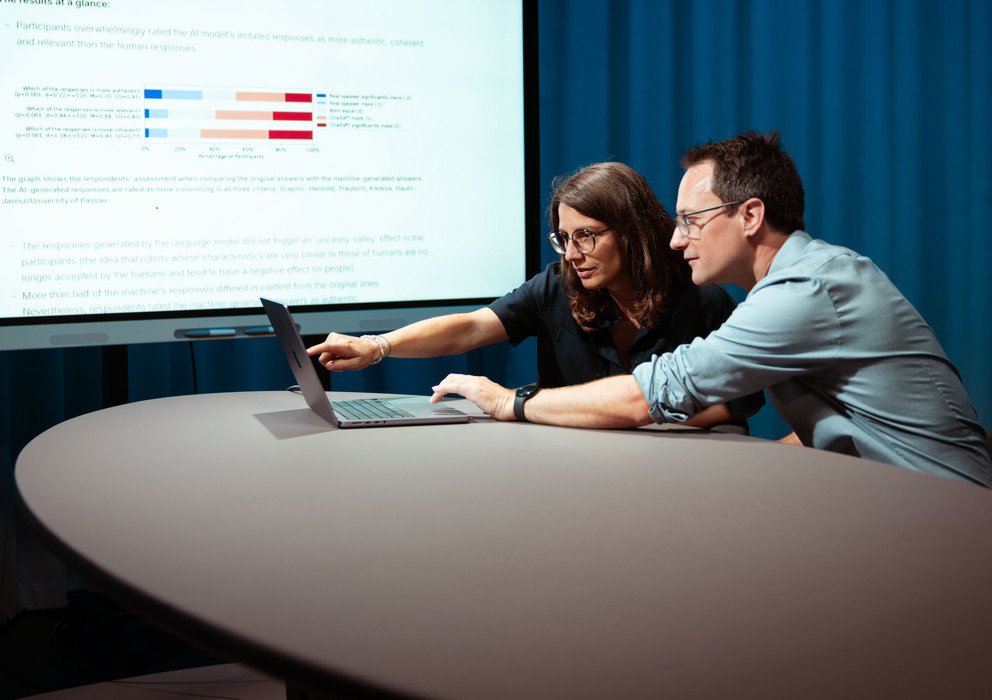
The study, led by computer scientist Professor Steffen Herbold and computational linguist Professor Annette Hautli-Janisz, had barely been published when the researchers received an enquiry from a journalist at the British daily newspaper The Times. The journalist wanted to know whether the data could also provide insights into Britain’s future Prime Minister.
Who comes across as more authentic in political debates – AI or Andy Burnham? Professor Herbold had the data to hand: Burnham did indeed represent an outlier in the results. Burnham’s answers on the British political talk show "BBC Question Time" struck respondents as more authentic than the versions generated by ChatGPT. However, the UK’s next Prime Minister was the exception: for the most part, the citizens surveyed rated the answers imitated by the AI as more authentic, coherent and relevant than the actual answers – even where there were differences in content. For the study, the Passau researchers analysed a dataset comprising transcribed questions and answers from the British political talk show BBC Question Time (more on the study).
The British “Times” gave the story a prominent place: on its front page. The Passau study also attracted attention elsewhere (see overview). The researchers commented: “We are overwhelmed. We hadn’t expected this much attention at all,” says Professor Herbold. “I am delighted by the media interest. After all, our study also highlights the potential harm that could arise from the use of AI in political communication. It is important to educate the public about this," says Professor Hautli-Janisz.
In Germany, the study struck a nerve in a controversial debate: how much AI is permissible in politics and journalism? This question was discussed in the media in light of politicians’ speeches and journalistic commentaries written by AI.
Beyond the UK and Germany, media outlets in France, the Netherlands, Hungary and the USA, amongst others, covered the study. The national and international response to the research from Passau has delighted the University’s President, Professor Jan Hendrik Schumann: “This study demonstrates the strength of the University of Passau: we address future-oriented topics at an early stage and examine them from an interdisciplinary perspective. Artificial intelligence, in particular, is profoundly changing our society. That is why we need research that considers technological developments alongside their implications for democracy and social cohesion.”
Thematically, the study ties in with the University of Passau’s established research areas of ‘AI & Language’ and ‘Resilient Democracies’.
This text was machine-translated from German.
This overview is updated regularly.
Germany
Argentina
Australia
Brazil
Canada
France
Great Britain
Malaysia
Netherlands
Spain
Ukraine
USA





















![[Translate to Englisch:]](/fileadmin/_processed_/5/d/csm_IMG_3780_e5d58f2d3f.jpg "[Translate to Englisch:]")