Professor Carolin Häussler holds the Chair of Organization, Technology Management, and Entrepreneurship at the University of Passau and is Deputy Chair of the Commission of Experts for Research and Innovation (EFI) based in Berlin. The EFI provides scientific policy advice to the German federal government and publishes an annual report on research, innovation, and technological performance in Germany. In this video interview, the innovation expert reveals how she assesses the German government's high-tech agenda, where the weaknesses in the German innovation system lie, and why research and innovation are a security factor for Germany and Europe.
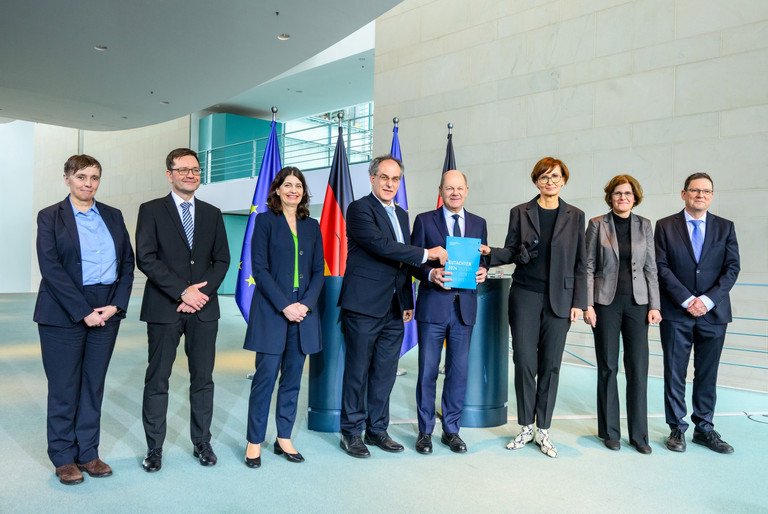
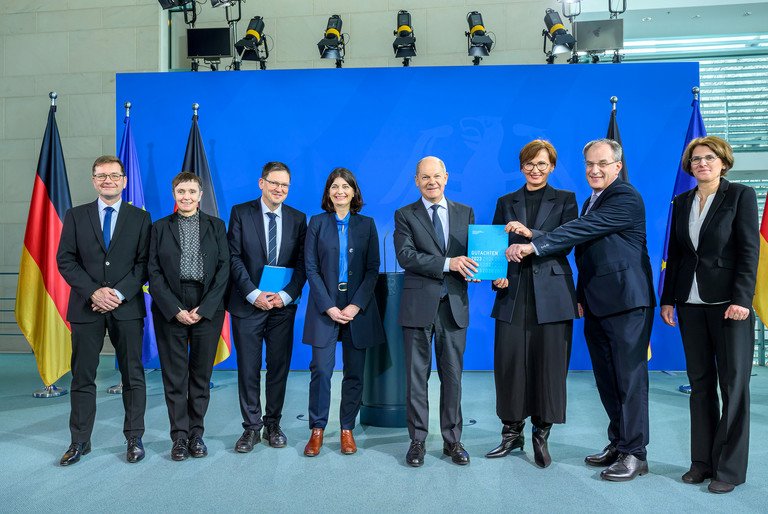
The EFI Commission presenting the 2026 Annual Report to Federal Chancellor Friedrich Merz (from left): Guido Bünstorf (v.l.), Joachim Henkel, Dorothee Bär, Irene Bertschek, Friedrich Merz, Carolin Häussler, Christoph M. Schmidt, Friederike Welter. Photo: Linda Köhler-Sandring
What topics does the EFI report 2026 address?
Professor Häussler: In the first part of the report, we assess the economic situation and performance of the research and innovation system and evaluate specific projects such as the German High-Tech Agenda, the EU Commission's 10th Framework Program, and the 28th Regime—a new EU legal framework for strengthening the EU internal market. In light of the current threat situation, we also address security-related research and innovation.
In the second part, we focus on three specific topics in separate chapters. In the 2026 report, these are:
How do you rate the German government's High-Tech Agenda?
I hope it will be a great success. It certainly sends a strong signal about the priority given to research and innovation and the focus on selected key technologies.
In the EFI Commission, we analysed the key technologies prioritised by the High-Tech Agenda, including artificial intelligence, biotechnology, microelectronics and climate-neutral energy production. Our analyses show that the challenges for Germany lie less in research, where we are well positioned, and more in application. This is an indication of a weakness in the German innovation system when it comes to transferring research findings into application.
What role do universities play in Germany's innovative strength?
There are many examples of innovative technologies from university research laboratories that have become commercially successful – such as mRNA technology, which has contributed significantly to the rapid development of COVID-19 vaccines. Excellent research can therefore be a key success factor for innovative strength.
In short, much of the knowledge generated here is exploited elsewhere. It's a bit like ‘knowledge made in Germany – but profit made abroad’.
It is very encouraging – and our report shows this – that excellent research is being carried out at Germany's higher education institutions, especially universities, which is now much more relevant to global innovation than it was a few years ago.
But we fail to exploit this potential. German scientific findings are incorporated into patents much less frequently than US-American ones. Despite the high potential, research-based academic start-ups and patent applications from universities have actually been declining recently. In addition, a significant portion of the economic returns from this research goes abroad. In short, much of the knowledge generated here is exploited elsewhere. It's a bit like ‘knowledge made in Germany – but profit made abroad’.
That sounds like a missed opportunity. Why can't Germany make better use of its own scientific findings for innovation?
There are several reasons. On the one hand, the transfer structures at many universities and universities of applied sciences are not professional enough and inadequately equipped. Secondly, there is a lack of career incentives for scientists to get involved in transfer – career decisions still depend primarily on publications in journals or third-party funding. However, the often months-long negotiations between universities and founders over intellectual property are particularly problematic. These delays can cause transfer and start-ups to fail before they even get off the ground
What would need to change so that our universities could better exploit their innovation potential?
We propose a transfer time initiative. Time is critical for innovation in many ways – especially in the global innovation race. The transfer time initiative is intended to provide targeted freedom to focus on transferring research results into practice or on founding start-ups.
Closely related to ‘time’ are the hurdles involved in dealing with intellectual property. Currently, negotiations on the relevant rights between universities and founders or companies often take months – this slows down innovation and, in the worst case, means that ideas are not implemented at all. We urgently need procedures that are faster and more flexible. Clear guidelines for the fair distribution of rights and revenues should also be established, giving all parties involved – universities, scientists and companies – planning security.
Another important point is the gap in the funding chain between basic research and commercialisation. There is a lack of targeted support in this phase. Programmes that specifically close the gap between publicly funded research and marketable innovations can help here. Ultimately, however, transfer must be practised at universities and understood by all as an ongoing task.
What is the situation regarding artificial intelligence (AI) in Germany?
Our analyses show that, despite a strong research base, Germany and the European Union are still lagging behind in terms of the economic use of AI. This is dangerous because it means we risk becoming permanently dependent on non-European providers.
Our recommendations here are very clear: whether it's AI models, computing infrastructure or data, in order to strengthen digital sovereignty, it is urgently necessary to anchor central elements of AI value creation in Europe and reduce security-related dependencies on non-European providers.
How can security-related research and innovation be strengthened so that we can respond to the new threat situation?
The threat situation is indeed more complex and acute than ever before. We are talking about so-called hybrid threats, which include not only military dangers, but also cyber attacks, economic pressure and targeted disinformation – especially via social media.
We need to be strategically and technologically better positioned than those who threaten us so that we can deter them and defend ourselves in a conflict. This is therefore very much a question of technological leadership.
These challenges require not only swift but also strategic responses. Innovation is the best way to counter these threats. We need to be strategically and technologically better positioned than those who threaten us so that we can deter them and defend ourselves in a conflict. This is therefore very much a question of technological leadership.
As a commission that views the issue from the perspective of research and innovation, three key points are important: First, security policy strategy capabilities must be increased. Politicians must be able to act in an informed and strategic manner in an environment of changing threats. They must be able to draw on expertise – and for this, security-related research and teaching should be strengthened – in particular, one or two scientific beacons should be established or expanded that specialise in security policy-related topics and transfer this knowledge to policymakers.
Secondly, the circle of actors in the defence sector must be expanded. It is not enough to rely on established actors. New players – such as start-ups, interested companies and scientific institutions – must be involved and networked with the armed forces in order to promote innovative solutions. The Bundeswehr's new innovation centre in Erding near Munich, where research, innovation and military practice are brought together, sounds promising.
Thirdly, innovation-oriented procurement of defence equipment must succeed. There is untapped potential here.
What is meant by innovation-oriented procurement and what needs to change?
Former Parliamentary Commissioner for the Armed Forces Eva Högl summed it up aptly: ‘Innovative solutions often fail to find their way through existing structures.’ That is precisely what needs to be changed. We recommend setting up an independent arm within the Bundeswehr's procurement office that is responsible for procuring innovative solutions and, accordingly, acts in a way that promotes innovation with a high degree of freedom and a positive culture of error.
An innovation quota could ensure that a fixed proportion of funds is spent specifically on innovation-oriented procurement instruments. This would give greater emphasis to innovative procurement. The quota could be limited in time.
Breakthrough innovations are of central importance, especially in the defence sector – Germany must be at the forefront of technology in this area. In order to drive breakthrough innovations forward, they should be promoted outside the traditional procurement structures – for example, by expanding the Federal Agency for Breakthrough Innovation (SPRIND) or establishing an independent agency. This agency could enter into strategic partnerships with other EU and NATO countries and possibly be expanded into a European innovation agency in the long term.
This text was machine-translated from German.