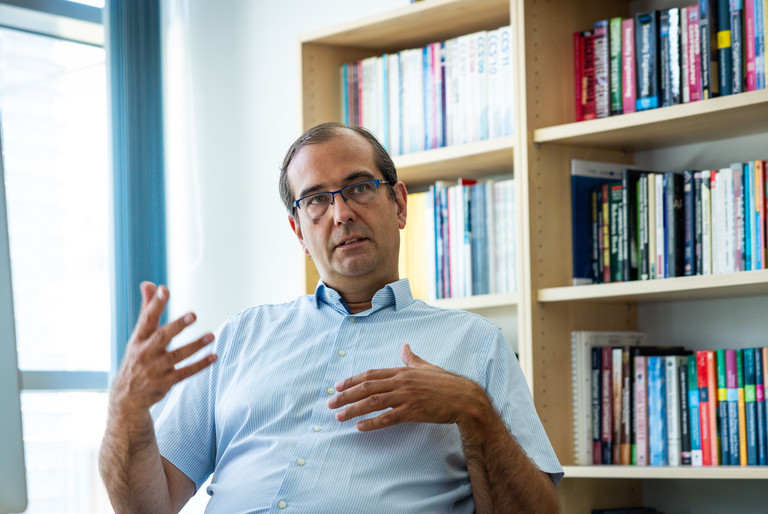
Professor Hans P. Reiser has returned to his home town of Passau – this time as the incumbent of the Chair of Digital Security. One of his main research interests is the detection and analysis of attacks, including attacks on the smart home. He is thereby strengthening a team at the University of Passau that conducts interdisciplinary research on cybersecurity for the everyday home. Previously, Professor Reiser was involved in setting up the Icelandic national coordinating centre for cyber security (NCC-IS/Eyvör) and founded the Frostbyte Research Centre at Reykjavik University, through which the university contributes to the work of the NCC-IS. Among other things, the laboratory infrastructure there makes it possible to study cyber attacks in real time.
Professor Reiser, what are honeypots?
Professor Reiser: In cyber security research, we use the term "honeypots" to describe deliberately established systems that are intended to attract attackers. This can be implemented in various ways, ranging from simple simulations to so-called high-interaction honeypots, which are based on real IT systems. At Reykjavik University in Iceland, my research team used such honeypots to study the behaviour of attackers. This research is now being continued, among other things, within the new FrostShield project, which is funded by Rannís, the Icelandic research funding agency. Our high-interaction honeypots provide a realistic IT environment with the functions of an ordinary production system. From the outside, they are hard to distinguish from real systems. The key difference: no real production data is processed.
And what do you observe in your honeypots?
Very often we find crypto miners. These are pieces of malware that are installed on the system after a successful attack and use its computing power to mine cryptocurrencies. Admittedly, this is no longer all that profitable nowadays. However, since the attackers use other people's computing power and barely incur any costs themselves, it apparently continues to be worthwhile. Attackers also frequently use compromised systems as a springboard for attacks on further systems.
How quickly do you make a find in your trap?
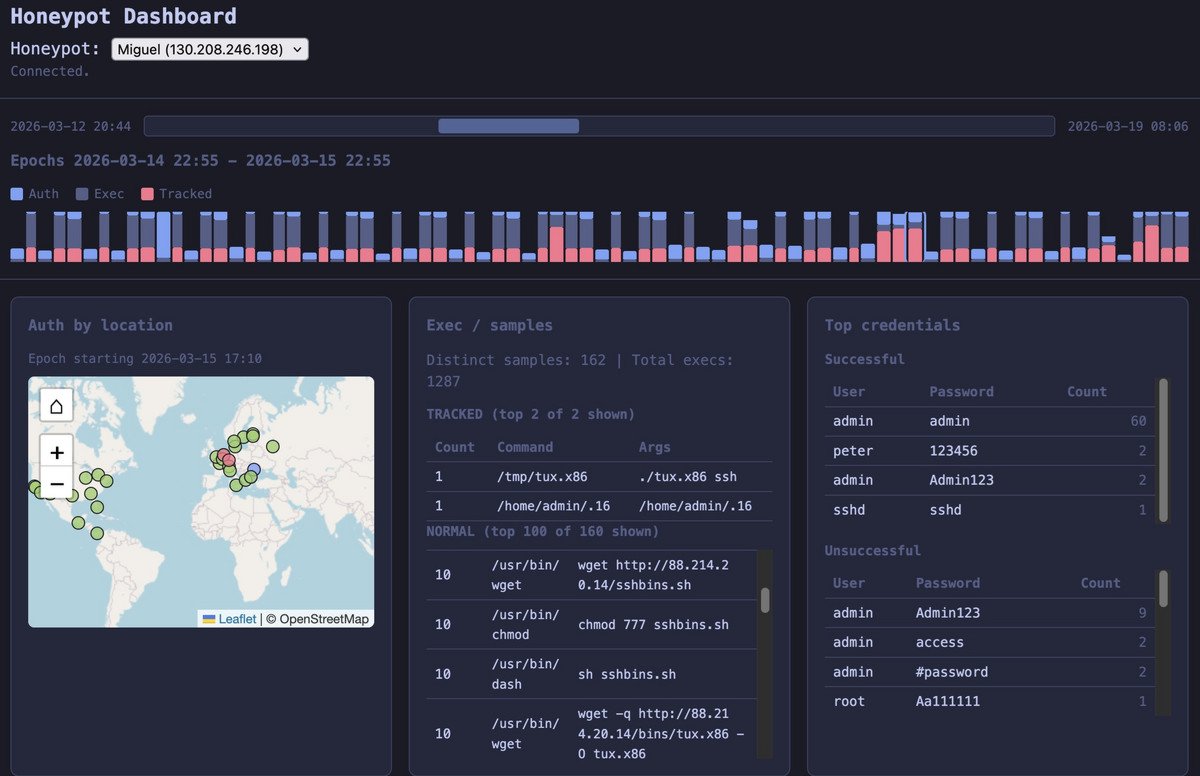
Amazingly quickly. Attackers constantly scan the internet automatically for vulnerable systems. Our honeypots are therefore often detected and attacked within a short space of time, sometimes in a few minutes. This allows us to observe and analyse the attackers' modus operandi directly.
How do attackers go about it?
Often using astonishingly simple methods: they copy malware onto the target system and run it there. It gets interesting from a research perspective when attackers use more sophisticated techniques to cover their tracks. One example is so-called fileless attacks, in which malware is executed without a conventional file on the hard drive.
What exactly happens there?
If malware is stored on the hard drive, a virus scanner can detect it. Experts can easily find the traces during an investigation, for instance by coming across a file that should not be there. That is precisely what skilled attackers want to avoid. In fileless attacks, malware is therefore often executed directly in the working memory, without first being placed on the hard drive. If the computer is switched off, the traces in the working memory are lost. This makes any subsequent investigation considerably more difficult.
Which attacks can cause particularly great damage?
Ransomware attacks in particular are regarded with great concern. In these attacks, attackers encrypt their victims' data and demand a ransom for its release. Such attacks can bring entire companies or public authorities to a standstill. It is therefore important for us to detect and understand the attackers' methods as early as possible.
You also research security in the smart home, in other words the networked home. What is the problem there?
We are becoming ever more connected and are producing ever more digital data. One example: even a smart light bulb can provide information about when someone is at home and what habits they have. If such data is processed via external servers, that can be problematic for the protection of privacy. At the same time, there are significantly fewer security products for the smart home than for a large company, which can moreover afford expensive protective measures. It is rather unusual for households to invest in this area. In addition, households do not necessarily have cyber security experts on site. It is precisely this combination of technical and societal questions that makes the smart home such a fascinating research topic, one from which I also benefit enormously thanks to the collaboration with colleagues from other disciplines.
How did you get into your field of research?
During my degree in Computer Science in the 1990s, cyber security was only a peripheral topic. However, I did work as a student assistant at the Chair of Operating Systems at FAU Erlangen-Nürnberg. The then chair holder, Professor Fridolin Hofmann, did a great deal of research on "Byzantine fault tolerance". This is about building systems in such a way that they continue to function correctly even if individual components fail or have been tampered with. That is the path by which I came to cyber security.
To what extent have attacks changed since then?
There are security vulnerabilities that were already a problem 30 years ago and still are today. Simple programming errors, for example, where inputs are not checked properly. Such vulnerabilities can easily be exploited over the internet. There has certainly been progress in protective measures. Yet practice often paints a frightening picture: for instance, many successful ransomware attacks still exploit entry points that have been known for years, such as fraudulent phishing emails, because even today there is often still a lack of basic security awareness. And the recent incidents involving AI show that the problem of attacks is not getting smaller – it is getting bigger.
This text was machine-translated from German.

How can we make our everyday digital life secure? In the established research area "Cybersecurity and Data Protection", our researchers examine the technical, economic and legal aspects of IT security. More information on the topics and the participating researchers