The interdisciplinary Laboratory for Democracy Education aims to develop educational programmes that strengthen open, liberal and human rights-based democracy through research, teaching and social dialogue.
Professor Inken Heldt during her speech at the launch event for the Laboratory for Democracy Education. The video is in German.
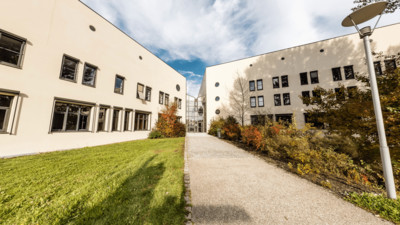
‘The lab is a powerful symbol at a time when democracies around the world are under pressure,’ emphasised Minister of State Dr Florian Herrmann in his speech at the end of October in the Audimax Building of the University of Passau on the occasion of the launch event for the Lab for Democracy Education. ‘It aims to teach open exchange of opinions as a fundamental principle of democracy and to enable reflection on the past.’
The laboratory's work focuses on three topics: (1) living conditions in dictatorships and democracies, (2) human rights education, and (3) social challenges posed by digitalisation. A key target group is teacher training students of all school types and subjects, who are expected to act as future multipliers of democratic education.
University President Professor Ulrich Bartosch emphasised the social responsibility of science: ‘Science depends on freedom. It is therefore the very essence of a university's mission to use its resources to promote this freedom. With the laboratory, the University of Passau is expanding its educational offerings on the topics of human rights and democracy, particularly in teacher training, as a transfer service.’ He expressed his personal gratitude to Reiner Kunze, who had resisted the totalitarian power claims of the SED regime with poetic means. The President also thanked the Reiner and Elisabeth Kunze Foundation and the Schwarz-Jany Foundation for their support in setting up the Laboratory for Democracy Education.
Professor Dr. Inken Heldt, Professor of the political system of the Federal Republic of Germany and political education, has taken over the management of the laboratory. ‘Political education must never be neutral,’ Heldt emphasised. "We want to encourage people to stand up for democratic values and human rights out of free self-determination – and to stand up for them whenever necessary. Democracy needs people who disagree – out of responsibility, not out of defiance.‘
Dr. Linda von Keyserlingk-Rehbein, historian and Kunze expert, is the laboratory's managing director. She added: ’We let experiences, biographies and historical testimonies speak for themselves so that younger generations can understand the dangers of totalitarian systems without having to experience them themselves." The first successful courses took place in the summer semester of 2025 – with discussions with contemporary witnesses and an excursion to the Regensburg Theatre, which offered students impressive educational experiences.
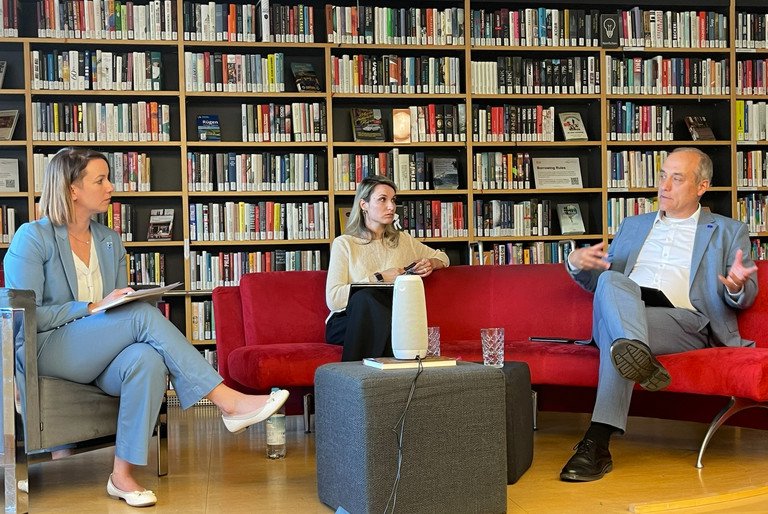
Sebastian Ritschel, artistic director of the Regensburg Theatre, set a cultural and political tone with his keynote speech on theatre as a space for experiencing dictatorship and democracy. In the subsequent panel discussion, he spoke with Silke Salzberger (headmistress of Hans Carossa Primary School), Andrea Carl (co-founder of the initiative Omas gegen Rechts (Grandmothers Against the Right) in Passau) and Martin Donaubauer (teacher training student) about specific challenges and threats to democracy education from the perspective of civil society, schools and universities.
All panel guests agreed: the new laboratory should become an open place of exchange – at the university and far beyond. A place where democracy is not only researched, but also reflected upon and experienced.
This text is machine-translated from German.