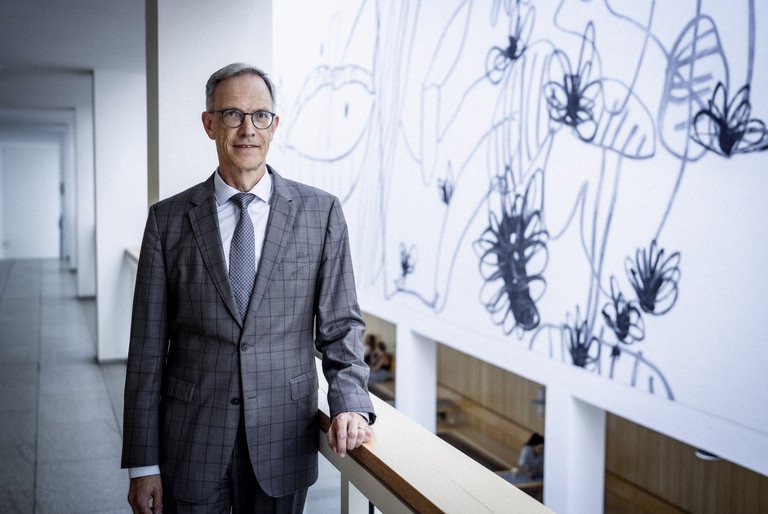
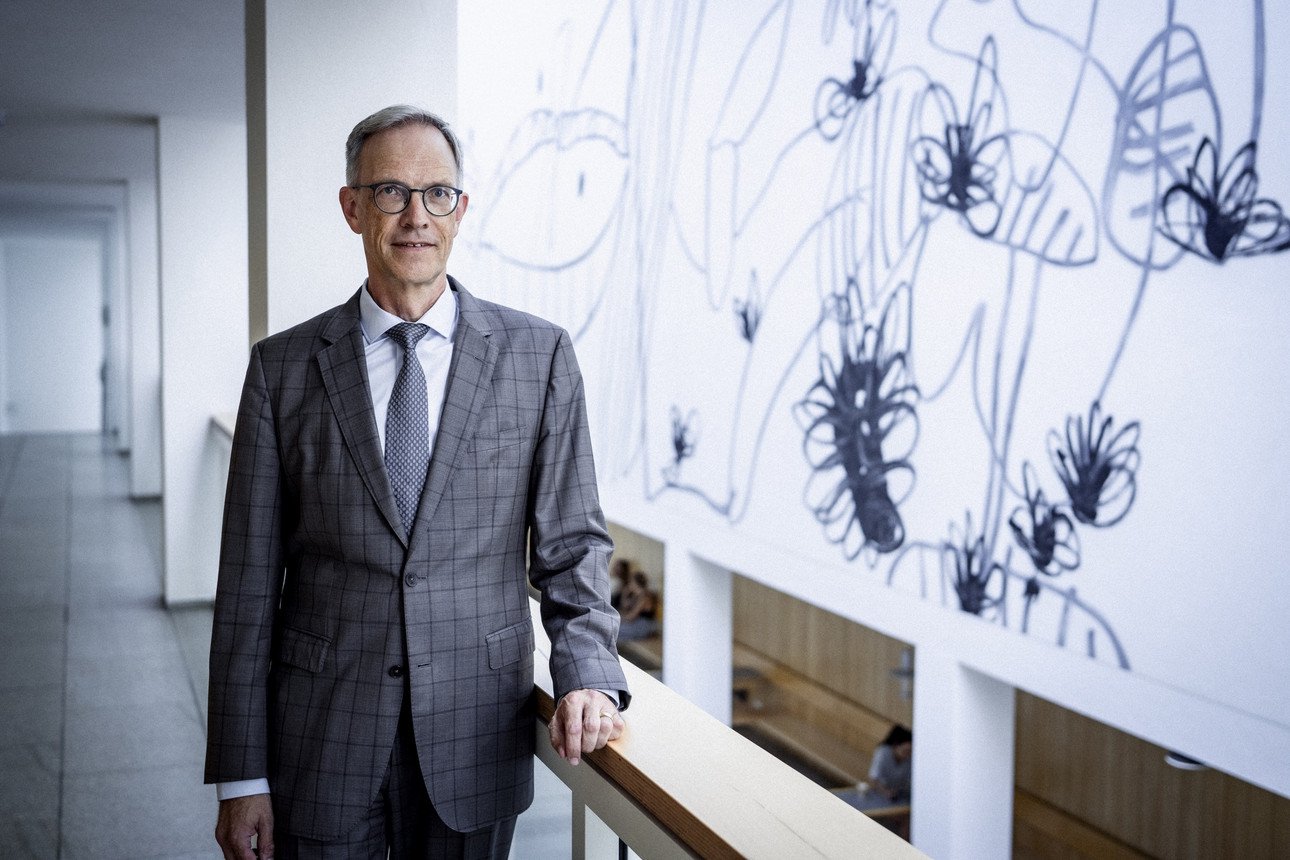
‘An exciting and instructive, but certainly also challenging time": Passau legal scholar Professor Hans-Georg Dederer is one of the newly appointed members of the German Ethics Council.
The President of the German Bundestag, Bärbel Bas, has appointed the members of the German Ethics Council for the new term of office with effect from 10 October. Passau legal scholar Prof Dr Hans-Georg Dederer is one of the newly appointed members.
The German Ethics Council was established in April 2008 on the basis of the Ethics Council Act of July 2007. The Council's mandate is to monitor the ethical, social, scientific, medical and legal issues arising in connection with research and development, particularly in the field of life sciences and their application to humans, as well as the likely consequences for individuals and society.
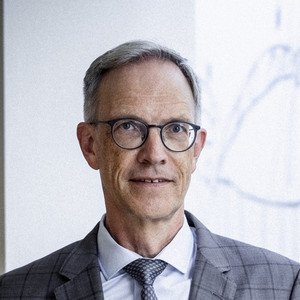
During the new term of office, Professor Hans-Georg Dederer, a legal scholar and holder of the Chair of Constitutional and Administrative Law, Public International Law, European and International Economic Law at the University of Passau, will also be a member of the German Ethics Council for the first time.
‘Of course, it is a great pleasure to have been appointed to the German Ethics Council,’ said Dederer. ’I hope that I can contribute substantively to the discussions of the Ethics Council by drawing on insights from my research on the law of the life sciences. In any case, it will be an exciting and instructive, but certainly also challenging time.’
University President Professor Ulrich Bartosch: ‘I warmly congratulate my colleague Dederer on this honourable appointment. The Ethics Council is gaining a highly respected, internationally experienced academic personality with excellent expertise. This choice is an excellent one. As a university, we at the University of Passau can also see this as an honour and are particularly pleased for the Faculty of Law.’
Further members of the Ethics Council appointed
In addition to Dederer, the following experts have been appointed for a first or second term (in alphabetical order): Jutta Allmendinger, Petra Bahr, Cornelia Betsch, Uta Eser, Aldo Faisal, Helmut Frister, Nils Goldschmidt, Winfried Hardinghaus , Ute Kalender, Hedy Kerek-Bodden, Armin Nassehi, Annette Riedel, Frauke Rostalski, Kerstin Schlögl-Flierl, Susanne Schreiber, Josef Schuster, Muna Tatari, Gregor Thüsing, Achim Wambach and Eva Winkler. Elisabeth Gräb-Schmidt, Armin Grunwald, Mark Schweda and Judith Simon are already members of the Council. They were appointed during the last term of office and their term of office has not yet expired.
The Council members perform their four-year mandate on a voluntary basis and may be reappointed no more than once. They represent scientific, medical, theological, philosophical, ethical, social, economic and legal concerns in a special way. In addition to scholars and scientists from the above-mentioned fields, the Council also includes individuals who are particularly familiar with ethical issues in the life sciences. They are intended to reflect the diversity of opinion in society. At its constituent meeting on 14 November, the Council will elect a new chair and board.
More information
About Professor Hans-Georg Dederer
The legal scholar holds the Chair of Constitutional and Administrative Law, Public International Law, European and International Economic Law at the University of Passau since 2009. For many years, his research has also focused on legal issues raised by new technologies, particularly in the fields of biology and medicine (e.g. gene, stem cell and reproduction technologies).
Dederer is a member of the Permanent Senate Commission of the German Research Foundation (DFG) for Genetic Research since 2018 and a member of the Standing Committee ‘Life Sciences’ of the German National Academy of Sciences Leopoldina since 2023.