Professor Armin Bergmeier is the new Heisenberg Professor at the University of Passau and holds the Chair of Art History and Material Culture. His research centers on the question of methodological renewal in art history.
For many, the term ‘cultural heritage’ conjures up thoughts of UNESCO, which has for the last 80 years protected humanity’s unique cultural and natural assets. Yet the tradition of preserving and reusing objects and architectural elements is much older. Through his research, Professor Armin Bergmeier of the University of Passau aims, amongst other things, to anchor cultural heritage research more firmly within the discipline of art history.
Professor Bergmeier has held the Chair of Art History and Material Culture at the University of Passau since July 2026. His research will be funded for five years as part of the prestigious Heisenberg Professorship from the German Research Foundation (DFG), which supports outstanding academics who can demonstrate their eligibility for a professorship through a habilitation and have a track record of particularly outstanding academic achievements. Through the highly competitive grant, Professor Bergmeier secured more than 600,000 euros in funding for his work.
Fields of Research
A major aspect of his research centers on the use of spolia, artifacts – such as a fragment of a sculpture or an ornament from an older building – which are reused in a new structure. Although this phenomenon has long been discussed in art history and archaeology, Dr Bergmeier notes that the “use of spolia reveals how cultural heritage was curated in the past – long before a concept such as UNESCO even existed.” Through his work on spolia, he aims to establish cultural heritage research – as an investigation into change – as a central subject of study within art history.
Professor Bergmeier devotes the second focus of his research within the framework of the Heisenberg Professorship to the critique of epistemology: the critical engagement with the past and its evaluation. “To date, scholarly investigation in cultural heritage research has mostly focused on the historical or contemporary evaluation of objects. The question of whether our modern perspectives (epistemes) distort and color our view of the objects is often ignored,” according Professor Bergmeier. This raises the question: what structures underpin the production of knowledge in the use of objects, both historically and today? His attention is directed towards aspects of use, preservation, excavation, exhibition, forgery, restoration, and expropriation. Such an approach challenges the narratives that have conferred meaning upon the objects and practices across different eras.
About the Author
Professor Armin Bergmeier holds the Chair of Art History and Material Culture at the University of Passau. From 2003 to 2010, he studied art history and cultural studies at Humboldt University in Berlin and received his PhD from Ludwig-Maximilians-University in Munich. His academic career took him to the University of Leipzig, where he completed his habilitation in 2023 and took up a position as a visiting professor of European and global medieval art history. He was a visiting scholar and held international fellowships in New York, Istanbul and, most recently, in Vienna.
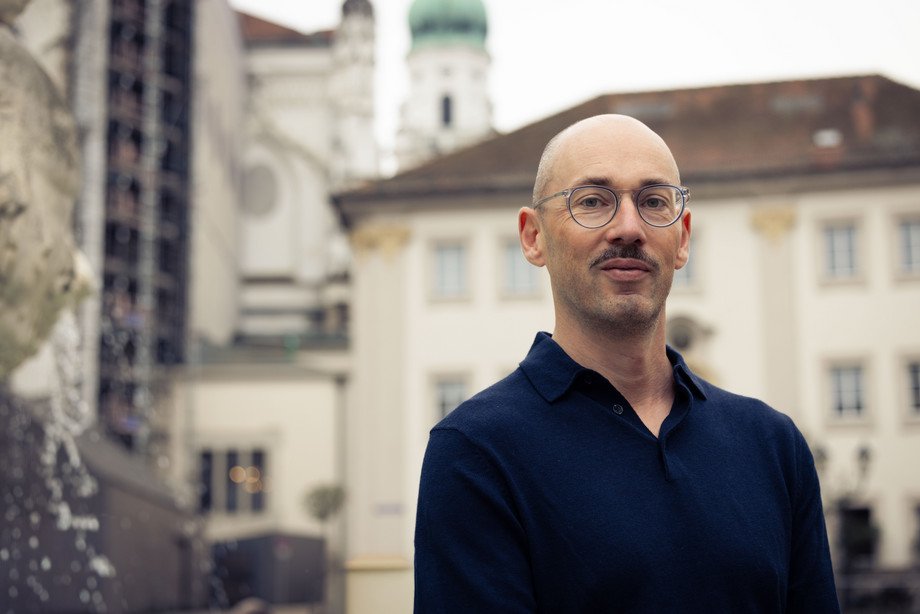
Among other things, Professor Armin Bergmeier researches the phenomenon of architectural reuse. In the background, an example of this approach to preserving cultural heritage can be seen: when Passau Cathedral was rebuilt following the devastating city fire in the 17th century, Italian master builders incorporated remains of the Gothic cathedral into the new Baroque structure.
| Principal Investigator(s) at the University | Prof. Dr. Armin Bergmeier (Lehrstuhl für Kunstgeschichte und Materielle Kultur) |
|---|---|
| Project period | 01.07.2026 - 30.06.2031 |
| Source of funding |

DFG - Deutsche Forschungsgemeinschaft > DFG - Heisenberg-Professur
|
| Projektnummer | 555746433 |